

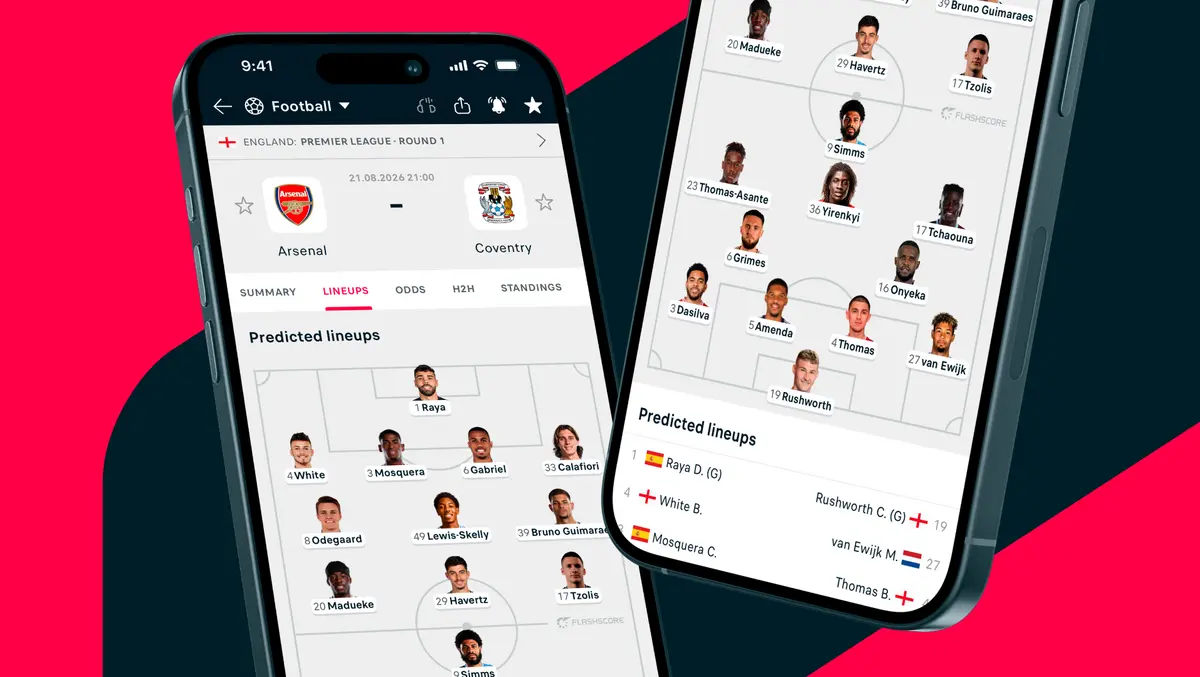
Flashscore claims top accuracy in predicted line-ups
Thu, 20th Aug 2026 (Today).webp)
Flashscore says its predicted football line-ups were the most accurate among the services it tracked across major European competitions, a result it attributed to a mix of automated analysis and human editing.
Data from the 2025/26 season showed an average of 1.67 incorrect players per predicted line-up across the top five European leagues and the Champions League. The nearest competitor averaged 1.98 incorrect players, while other services ranged from 2.01 to 2.17.
The figures cover predicted starting XIs published before official team announcements. For manually managed matches, Flashscore typically makes its line-ups available at least 48 hours before kick-off.
Interest in the information is especially high around the Premier League, its most viewed competition in the 2025/26 season. Flashscore recorded 7.14 billion match-detail views for the league between July 2025 and May 2026, with individual matches drawing up to six million users on average.
At peak levels, Premier League fixtures attracted more than 10 million users and over 40 million views. Manchester City's match against Arsenal in April was the most watched on the platform, drawing more than 11 million users and over 41 million views.
Two systems
Flashscore runs the feature in two modes. In manual mode, used for higher-profile competitions and international tournaments, editors review and publish each predicted line-up after the system prepares a first version.
In automatic mode, used for less-followed competitions, the system generates and publishes line-ups on its own. Human editors step in only when the model cannot fill a position with enough certainty.
At the centre of the process is what Flashscore describes as a player coefficient. The score takes into account recent minutes played, performance ratings, injuries, suspensions and the team formation used most often.
The company also applies a positional rule based on historical use. Players must have started in a given position within the previous six months, or the system will not place them there.
"The system is built on a set of well-tested rules and calculations. It's not just about who played last week - we look at recent form, availability, and tactical patterns. The goal is always to give the user the most probable starting eleven based on the information we have at any given moment," said Tomáš Pondělík, Chief Product Officer at Flashscore.
He said the rule can leave gaps that require manual intervention. "We have a condition, for example, that a player must have historically started in a specific position within the last six months - otherwise the system simply won't use them there. It improves accuracy, but it also means that sometimes the algorithm can't fill all eleven positions on its own. That's when a notification is triggered and a human editor steps in to resolve it," Pondělík said.
Editing window
For manually handled fixtures, the first predicted line-up can be generated 72 hours before kick-off. Editors then review it, compare recent selections and monitor updates such as injuries and managers' comments before publishing and revising it as needed.
That process continues after publication. "From the moment we publish the line-ups, the work never really stops. We're constantly reviewing and updating them so that users always see the most accurate prediction possible based on what we know," Pondělík said.
La Liga produced Flashscore's best results, with an average error rate of 1.29 incorrect players per line-up. The Dutch Eredivisie followed at 1.59, while its figure for the 2026 World Cup was 1.74.
The business uses an internal quality threshold of up to three incorrect players per line-up. Anything above that level triggers a review, and Flashscore said that had not happened so far.
Scale is central to the operation. Flashscore publishes around 500 predicted line-ups each week, with more than 60% of the total produced at weekends.
"We publish around 500 line-ups every week, with more than 60% of that volume concentrated at the weekend. Maintaining consistent accuracy at that scale is something we're genuinely proud of," Pondělík said.
Flashscore also plans to move six competitions from automatic mode to manual mode as audience demand grows in those markets: Argentina's Liga Profesional, Brazil's Serie B and Paulista, Portugal's Liga Portugal, Turkey's Süper Lig and the USA's MLS.
Flashscore is the main consumer brand of Prague-based Livesport. It has nearly 200 million app downloads and more than 125 million monthly users across more than 70 websites, covering 38 sports in over 50 countries.