

Adobe adds agent tools to Experience Manager Forms

Adobe has added new agent-based tools to Adobe Experience Manager Forms, aimed at form creation, discovery and completion.
The update includes a Brand Experience Agent for building or updating forms, a Development Agent for technical configuration, and new features for conversational form-filling and personalised follow-up communications.
Forms sit at the centre of many customer journeys, including sign-ups, approvals, activation and service requests. But they often remain a weak point in digital experiences because production is slow, surfacing them at the right moment is difficult, and completion flows are still largely fixed.
Creation tools
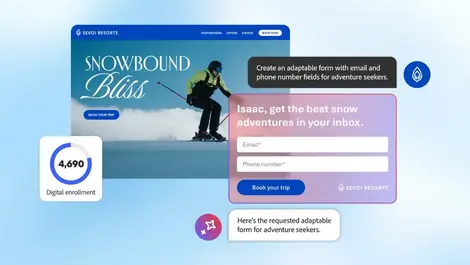
A central part of the update is the Brand Experience Agent, which can be used to create forms. Teams can import existing forms alongside web pages or create new ones from a short brief or an image using prompts.
The system recommends approved templates and reusable fragments, while matching a form's styling to the surrounding page. Adobe said this is intended to help marketing teams and content authors create or revise forms more quickly and reduce the need for IT involvement in routine changes.
The same agent also includes a communication creation tool for producing follow-up messages, including personalised application summaries. These communications can be generated through prompts and delivered through other Adobe products, including Adobe Journey Optimizer.
For technical teams, Adobe has introduced a Development Agent to help connect data sources and set up workflows through guided configuration. Developers can also use it to build custom components when more specialised work is required.
Adobe presented the additions as part of a broader effort to shorten production cycles for forms and related content while keeping work aligned with brand and compliance requirements.
Discovery focus
Adobe is also aiming to make forms easier to find and more relevant to users. Adobe Experience Manager Forms now supports audience-based and event-based personalisation through integrations with Adobe Experience Platform and Adobe Journey Optimizer.
Form responses can update user profiles in real time, allowing forms to adapt based on audience segments or behavioural triggers. Instead of presenting the same fixed sequence to every user, a form can change according to context.
Another part of the announcement centres on what Adobe describes as agentic optimisation. Forms such as contact requests or credit card applications can be structured not only for conventional search and direct human use, but also for discovery through software agents in intent-led interactions.
For human visitors, teams can use Experience Manager Sites Optimizer to identify issues with navigation, placement and accessibility that may affect conversion. For agent-driven interactions, forms can be refined to surface in ways that better match user intent.
Completion changes
Adobe also outlined changes to how users complete forms. Adobe Experience Manager Forms now includes agentic form-filling functions designed to support both direct user input and actions carried out by agents on a user's behalf.
Users can fill in forms by typing responses or through conversational interfaces. Those interfaces can be embedded on a company's own site, including within Brand Concierge, or used offsite through first-party or third-party assistants.
Adobe said its form-filling agent interprets user inputs and captures the required information in the background. The goal is to let the experience adapt to the context and intent of the interaction rather than rely on a rigid, question-by-question process.
The announcement reflects a broader push by software providers to apply agent-based systems to routine business tasks that have traditionally relied on manual setup, static workflows and separate tools. In Adobe's case, the latest changes place forms, often one of the most operational parts of a digital journey, at the centre of that strategy.
Adobe said the tools are intended to cover the full process around forms, from initial build and technical integration to discovery, completion and follow-up communication, while reducing friction in high-intent customer journeys.
"The result is more forms completed by meeting users wherever they engage, while capturing the right information."